
The Quiet Renaissance of European Small Hydro
Small hydropower works without drama, which is most of the reason it gets overlooked. Yet across Europe these stations below 10 MW add up to nearly 25,000 MW of capacity and supply well over 13 million households.
A large sector, hidden in plain sight
A run-of-river plant on a mountain stream or an old mill leat makes no noise in the news and very little on the grid map, yet across Western, Northern and Southern Europe these stations below 10 MW add up to nearly 25,000 MW of capacity. They supply electricity to well over 13 million households. Italy alone runs more than 3,600 MW of them; France, Spain, Germany and Austria each count theirs in the thousands. The sector is large precisely because it is dispersed.
Set against Europe’s total hydropower capacity, small hydro is a modest share, around an eighth of the installed megawatts. By plant count it is the overwhelming majority: roughly 90% of Europe’s hydropower stations are small. That mismatch, many plants and a small slice of capacity, is the defining feature of the sector. It means thousands of independent operators, thousands of separate sites, and a maintenance and modernisation problem spread across an entire continent rather than concentrated in a handful of large dams.
Why the grid wants it back
The reason small hydro is being looked at again is the changing shape of the grid. As wind and solar take a larger share of generation, the system needs sources that can steady them: output that is predictable across a day, that responds quickly, and that supports voltage and frequency close to where electricity is actually used. Run-of-river plants do this without the transmission losses of moving power across borders, and they do it from infrastructure that, in many cases, has stood for the better part of a century. Flexibility that once seemed quaint has become the argument for keeping these stations alive.
None of this makes small hydro a major pillar of supply, and it does not need to be. Its value is qualitative as much as quantitative: dispatchable generation embedded in local networks, available when the wind drops and the sun sets, in places a large plant could never be built. A continent trying to firm up an increasingly variable grid has reason to value capacity that is already built, already connected and quietly dependable, even where each individual plant is small enough to overlook.
Modernised one plant at a time
Geography concentrates the sector. The Alpine countries, the Nordic uplands and the rivers of southern Europe hold most of the capacity, because small hydro needs the same thing everywhere: a reliable fall of water. Italy, Norway, France, Spain, Germany and Austria account for the bulk of it, and within each the plants belong to a patchwork of utilities, municipalities, cooperatives and family owners. That ownership structure is part of why modernisation is slow and steady rather than sweeping. There is no single operator to upgrade a fleet at a stroke, only many small decisions taken plant by plant.
The more telling number is the age of the fleet. Close to 60% of Europe’s hydropower capacity is more than 40 years old. A great many small plants are running on turbines and control systems specified decades ago, and the present investment goes less into new construction than into bringing what exists up to current standards. New small-hydro sites are scarce and contested; the existing ones can be modernised without a new dam, a new reservoir or a new fight over a river. Refurbishment, not greenfield, is where the sector’s money and engineering now concentrate.
Compliance is a measurement problem
Environmental regulation has raised the bar for that modernisation. The Water Framework Directive and the requirements around fish passage and ecological flow mean a plant cannot simply take what water it likes. It must guarantee a minimum flow at all times, adjust to changing conditions, and document that it is doing so. Meeting that obligation is, before anything else, a control problem. The plant has to know, precisely and continuously, how its turbines and gates are positioned, and adjust them within fine limits to honour the flow it is legally bound to leave in the river.
That control rests on measurement. The governor that regulates a turbine and the actuator that moves a gate both depend on knowing position and speed without ambiguity, in an environment that is wet, cold and full of vibration. The information comes from encoders, and an encoder is only as good as the graduated disc or scale at its centre. The fine patterning of those components, held to optical tolerances, is one of the quiet dependencies that decide whether a refurbished plant is both compliant and efficient. It is the kind of part Selba has made for decades, and the kind whose contribution is invisible until it is wrong.
Europe’s small-hydro fleet will not be rebuilt from scratch. It will be modernised, one station at a time, across thousands of sites and as many owners, under environmental rules that keep tightening. The work is incremental and largely unseen, which suits an industry that has always run quietly. The measurement that governs each plant will improve in the same way: not in a single leap, but disc by disc, as the old controls give way to better ones.
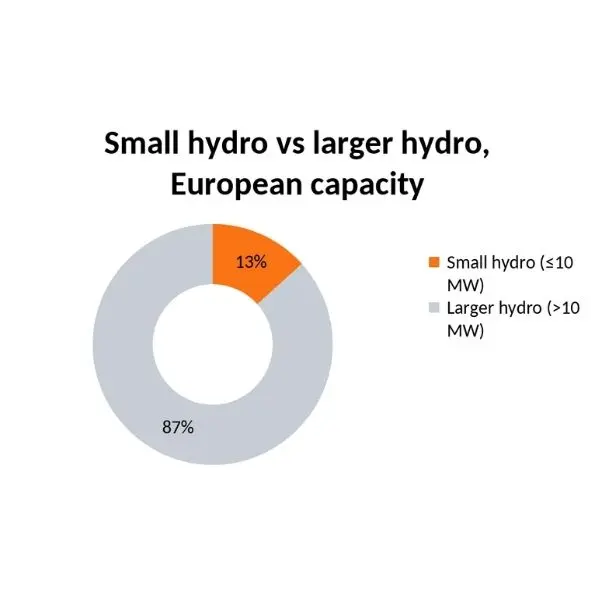
Small hydro as a share of total European hydropower capacity. © Selba
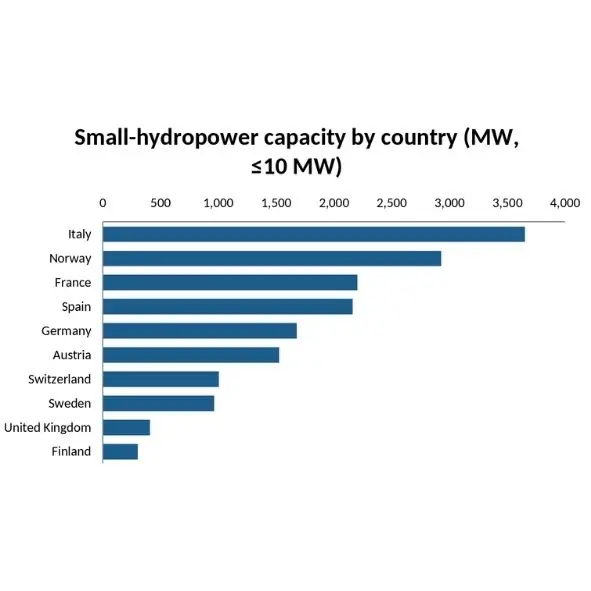
European small hydropower installed capacity by country. © Selba
- UNIDO & ICSHP, World Small Hydropower Development Report 2022 (unido.org/WSHPDR2022).
- Figures cover plants ≤10 MW; national definitions vary (Germany applies a ≤1 MW threshold).
Discuss your project with Selba
Every encoder disc, scale and photomask is made entirely to your specification. Tell us your requirement and our engineers will assess feasibility, tolerances and lead time.
Request a quote