
Fine Glass Machining

Glass machining is the capability that transforms a patterned optical substrate into a finished, assembly-ready component. While photolithography defines what is on the glass, machining defines what the glass looks like — its external dimensions, edge profile, mounting features, and mechanical interfaces.

Product in details

Fine Glass Machining

Glass is among the most demanding materials to machine with precision — brittle by nature, sensitive to thermal shock, and prone to sub-surface crack propagation from even minor mechanical overload. Achieving tight dimensional tolerances on glass, particularly on thin substrates where fracture risk is highest, requires controlled process parameters and a deep understanding of how the material responds at each stage of the machining sequence. At Selba, this understanding has been translated into a proprietary glass machining capability built around equipment designed and built entirely in-house — configured specifically for the substrate materials, thickness ranges, and dimensional tolerances that precision optical component manufacturing demands.

The integration of glass machining and photolithographic patterning within a single facility is what makes Selba’s capability particularly distinctive.

Every machined component undergoes dimensional inspection before release, covering external geometry, edge condition, and — where applicable — registration between machined features and the optical pattern they reference.

  • Optics & Photonics
  • Precision Instrumentation & Metrology
  • Medical Devices & Imaging Systems
  • Watchmaking & High-End Micro-Mechanics
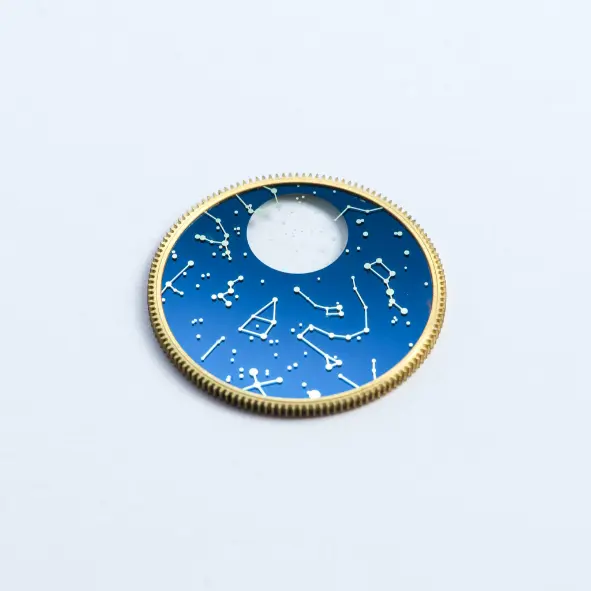
Selba's fine glass machining

PRODUCT SPECIFICATIONS

Technical Details

Complex Profiles. Tight Geometric Indexing. Substrates to 0.1 mm.

Selba’s glass machining operations cover cutting, edge profiling, drilling, and chamfering across a range of substrate materials including sodalime glass, quartz, and thin specialty substrates. The department’s machinery — designed in-house — is configured to maintain precise geometric indexing between the machined external shape and the photolithographic pattern the substrate carries, ensuring that the positional relationship between the optical pattern and the mechanical form of the finished component is held to the tolerances required by the assembly it will enter.
Drilling operations are supported on substrates as thin as 0.1 mm, with surface finish quality maintained throughout. Chamfered edge profiles are available for large-format substrates — including encoder discs up to 200 mm and beyond — where edge geometry is used to redistribute mechanical stress and improve structural rigidity without adding substrate mass. Custom tooling parameters are developed in-house for non-standard geometries, allowing Selba to address machining requirements that fall outside the capability envelope of standard glass processing suppliers.

Ultra-thin glass machining capability

Down to 0.1 mm thickness

High-precision dimensional control

Micron-level tolerances

Large-diameter component machining

Up to 200+ mm formats

Controlled material removal

Diamond cutting technology

Structural rigidity & durability

Chamfered edge profiles

Verified geometry and edge quality

100% dimensional inspection

PRODUCT SPECIFICATIONS

Custom Services

Integrated Patterning and Machining Under One Roof.

The primary service advantage of Selba’s glass machining capability is its integration with the photolithographic process. Because both operations take place within the same facility, the positional relationship between the optical pattern and the machined external geometry is controlled end-to-end by Selba — eliminating the tolerance stack-up that arises when patterning and machining are performed by separate suppliers. This is particularly significant for encoder discs, calibration plates, and optical components where the mechanical datum of the finished part must be precisely referenced to the optical pattern it carries.
As with all Selba production, glass machining programmes begin with a review of the customer’s design by Selba’s R&D team, covering substrate material selection, edge profile geometry, drilling feasibility, and the interaction between machining operations and pattern integrity. Prototype and first-article components are produced using the same tooling parameters that will govern series production, ensuring that the mechanical geometry validated at the prototyping stage is fully reproducible at volume. Selba’s glass machining capability also supports Swiss watchmaking maisons, for whom surface quality, dimensional precision, and component repeatability are non-negotiable requirements alongside the aesthetic standards inherent to high-end horology.

Integrated Patterning & Machining
R&D Design Review
Prototype to Series Production

CUSTOM & MASS PRODUCTION

Industrial Applications

Industrial Applications
Selba’s glass machining department operates diamond cutting machinery — a technology whose controlled abrasive cutting mechanism is uniquely suited to the hardness and brittleness of optical glass substrates. Unlike conventional tooling, diamond cutting removes material without initiating the crack propagation that brittle substrates are susceptible to, allowing tight dimensional tolerances to be held on external profiles, edge geometries, and drilled features across substrate materials from standard borosilicate glass through to the considerably harder quartz (fused silica). At thin substrate dimensions approaching 0.1 mm, cutting speed, feed rate, coolant flow, and tool engagement are developed specifically for each substrate thickness and material combination, controlling the out-of-plane forces that would otherwise initiate fracture in a substrate offering negligible bending resistance. Chamfered edge profiles — applied using diamond tooling configured for the specific chamfer geometry required — are produced to the dimensional consistency needed to reliably redistribute peripheral stress and increase substrate rigidity, rather than merely approximating the target profile. The in-house design of Selba’s diamond cutting machinery is central to this capability: standard commercial glass cutting equipment is not configured for the combination of substrate thinness, dimensional tolerance, and edge quality that precision optical component manufacturing demands, and Selba’s ability to specify and refine its own tooling platforms is what allows it to operate at the limits of precision glass machining.
Custom Services
Selba’s glass machining capability serves a broad range of industries and application types, each placing distinct requirements on the precision, surface quality, and dimensional accuracy of the finished glass component. In the Swiss watchmaking industry, Selba machines glass components for watch dials and decorative elements — applications where dimensional precision and surface finish quality must meet the exacting aesthetic and mechanical standards of high-end horology, with machined profiles conforming to tight tolerances while preserving the surface integrity that luxury timepiece manufacturing demands. In optics and photonics, Selba’s diamond cutting capability is applied to the resizing, dicing, and profiling of optical wafers for photonic component manufacturers — operations where the positional accuracy of the cut relative to the wafer’s optical structures, and the cleanliness of the diced edge, directly determine whether the resulting optical component performs within specification. In industrial applications, Selba provides precision glass cutting, resizing, and dicing services across a broad range of glass formats and substrate materials, serving customers requiring custom glass blanks, precision-dimensioned substrates, and diced components cut to tight dimensional tolerances from larger glass stock. In medical device manufacturing, Selba machines glass mirrors used in optical systems embedded within medical instruments — including endoscopes, where mirror elements direct and redirect the optical path within the instrument insertion tube; surgical microscopes, where precision mirror components form part of the beam-splitting and illumination optical train; ophthalmic diagnostic instruments, where mirror surfaces are used in fundus cameras, slit lamps, and optical coherence tomography systems to redirect and condition the measurement beam; and laser therapy delivery systems, where mirror elements direct high-power optical beams to the treatment site with the positional accuracy that safe and effective therapy requires. Selba also machines glass components for tripod-mounted and surveyor’s precision measuring instruments — including optical theodolites, total stations, and levelling systems — where glass graduation discs, reticles, and mirror elements require machining to the geometric tolerances and surface quality that the angular and linear measurement accuracy of geodetic instrumentation demands.

Use Case

Fast-Turnaround Optical Wafer Machining for a Global Photonics Manufacturer.

“Selba developed dedicated tooling parameters for the customer’s wafer geometry and substrate material, with particular attention to edge condition and surface finish throughout the machining sequence.”

FAQ

Frequently asked questions

What is precision glass machining?
Precision glass machining is the controlled shaping, cutting, profiling, drilling, and finishing of glass substrates to tight dimensional tolerances and defined surface quality standards. Unlike metalworking, where material is removed by shear cutting, glass machining relies on controlled abrasive processes — principally diamond tooling — to remove material without initiating the sub-surface cracking and edge chipping that brittle materials are susceptible to under conventional machining forces. The goal is to produce glass components whose external geometry — diameter, thickness, edge profile, hole position, and surface condition — meets the dimensional and surface quality requirements of the optical, mechanical, or metrology application the component will serve, while preserving the integrity of any photolithographic pattern the substrate carries. At Selba, precision glass machining is performed using in-house designed diamond cutting machinery, developed specifically for the substrate materials, thickness ranges down to 0.1 mm, and dimensional tolerances that precision optical component manufacturing requires — capabilities that standard commercial glass fabrication equipment is not configured to deliver.
What types of glass can be machined?
Selba machines two principal glass substrate families, each with distinct mechanical properties that require material-specific tooling parameters and cutting sequences. Borosilicate glass — including sodalime variants — is the standard substrate for encoder discs, calibration plates, photomask blanks, watch dial components, and general precision optical elements. Its moderate hardness and well-characterised fracture behaviour make it compatible with a broad range of cutting, profiling, chamfering, and drilling operations across standard thickness ranges. Quartz (fused silica) is significantly harder and more brittle than borosilicate, requiring slower cutting speeds, sharper diamond tooling, and more conservative material removal rates to achieve clean edge conditions and avoid sub-surface damage — but its exceptional thermal stability (≈0.55 ppm/°C) and UV transparency make it the required material for metrology, aerospace, deep-UV lithographic, and high-precision photonic applications. Across both substrate families, Selba processes substrates down to 0.1 mm thickness — a capability that demands fixturing, cutting, and finishing parameters developed specifically for the mechanical constraints of ultra-thin glass, using in-house designed machinery configured for this requirement.
What is the tolerance for glass machining?
Selba’s precision glass machining operations achieve micron-level dimensional accuracy on external profiles, edge geometries, and drilled features — tolerances that place glass machining at the boundary of what the material’s inherent brittleness permits and that require the controlled diamond cutting process and in-house designed fixturing that Selba has developed specifically for this purpose. Edge cutting accuracy is held at the micron level, enabling precise profile geometries, chamfer angles, and external dimensions to be produced repeatably across production batches without edge chipping, sub-surface cracking, or dimensional scatter that would compromise the mechanical or optical function of the finished component. Substrate thickness processable at Selba extends down to 0.1 mm — a dimension at which the glass substrate offers negligible resistance to out-of-plane machining forces, and where every process parameter, from diamond tool geometry and cutting speed through to coolant flow and workholding pressure, must be controlled specifically for the substrate thickness and material combination in question. At 0.1 mm, the interaction between the cutting tool and the substrate generates stress states that would fracture inadequately supported or improperly fixtured glass instantaneously — making the in-house design of Selba’s machining equipment, and the process knowledge embedded in its cutting parameters, the critical variables that make this thickness capability achievable in production rather than only in a laboratory setting. Chamfered edge profiles — produced to micron-level dimensional consistency using diamond tooling configured for the specific chamfer geometry required — are particularly important at thin substrate dimensions and large diameters, where the chamfer’s stress redistribution function must be geometrically precise to deliver the increase in peripheral rigidity and fracture resistance the application requires.
What industries use glass microfabrication?
Precision glass machining and microfabrication serve a broad range of industries wherever glass substrates must be shaped, sized, or structured to tight dimensional and surface quality requirements. The Swiss watchmaking industry relies on precision glass machining for dial components and decorative elements, where dimensional accuracy and surface finish must meet the exacting standards of high-end horology. The optics and photonics industry uses glass machining for wafer resizing, dicing, and profiling of optical substrates for photonic component manufacturing, where cut edge quality and positional accuracy relative to the wafer’s optical structures are critical. The semiconductor and electronics industries require precision glass cutting, dicing, and substrate preparation across a range of photomask and encoder applications. Medical device manufacturers use machined glass mirror components in endoscopes, surgical microscopes, ophthalmic diagnostic instruments including fundus cameras and optical coherence tomography systems, and laser therapy delivery platforms. The precision surveying and geodetic instrumentation industry relies on machined glass graduation discs, reticles, and mirror elements in optical theodolites, total stations, and levelling systems. Industrial customers across automation, metrology, and scientific instrumentation sectors require precision glass cutting, resizing, and dicing services across a broad range of substrate materials and formats.