
Aluminium Scales: Rethinking the Encoder Substrate
Glass has been the default substrate for encoder scales for as long as precision encoders have existed. What is changing is the assumption that glass is the only sensible choice.
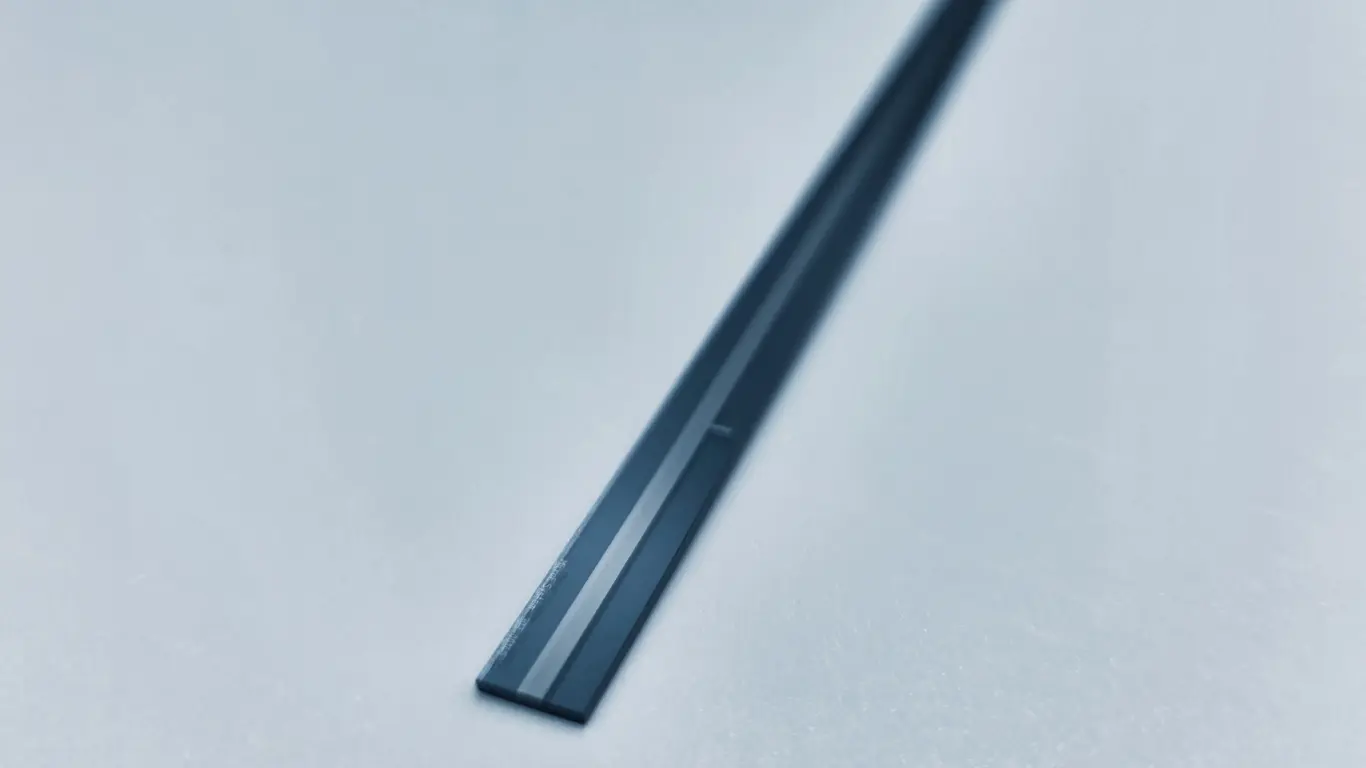
A Selba aluminium prototype scale. © Selba
Why question glass
Glass has been the default substrate for encoder scales and discs for as long as precision encoders have existed, and for good reasons: it is dimensionally stable, it takes a fine pattern, and it reflects light cleanly. None of that is about to change. What is changing is the assumption that glass is the only sensible choice. Selba expects 20% to 30% of the market for glass encoder discs to move toward aluminium-based substrates over the coming years, and the reasons are worth setting out, because each one answers a problem glass quietly imposes.
Three properties glass can’t match
Start with temperature, which is usually cited as glass’s advantage. Glass expands very little when it warms, and in isolation that looks like the property you want. But an encoder does not work in isolation. It is mounted to a machine, and most precision machines are built from aluminium. When that aluminium structure warms and grows, a glass scale fixed to it does not grow with it, and the mismatch shows up as measurement error. An aluminium scale expands at very nearly the rate of its aluminium host, so scale and machine move together and the reading stays consistent across a working temperature range. The benefit is not low expansion in the abstract; it is expansion matched to the structure the encoder is actually attached to. The exact gain depends on the assembly, and is worth confirming for a given design, but the principle is sound and counter-intuitive enough to be missed.
The second property is optical. An encoder’s read head works by reflection, and a substrate that cannot return a clean signal is no use however stable it is. Aluminium can be finished to a reflectivity approaching that of glass, which means the read head receives a signal of comparable quality. The substrate changes; the performance the encoder was specified for does not have to be renegotiated. This is the property that makes the other two usable, because without it the thermal and mechanical advantages would come at a cost in signal that few applications could accept.
The third property is the one that opens designs glass cannot reach. At a thickness of around 0.2 millimetres, an aluminium scale is flexible. It can be wrapped around a cylinder, which a rigid glass scale simply cannot, and that single fact makes cylindrical encoders feasible where they were not. For any instrument that needs angular or positional measurement on a curved surface, or that has no room for a flat disc, this removes a constraint glass imposes by its nature rather than by any failing. It is less an improvement on an existing part than a new shape of part altogether.
New shapes, and why the shift
The applications that gain most are the ones glass has quietly excluded. A rotary encoder built around a slim cylinder rather than a flat disc, a scale that has to follow a curved housing, an instrument where there is depth for a wrapped band but not for a rigid plate: these are designs engineers have worked around for years because the substrate would not bend. Removing that limit does not just improve them. It lets some of them exist at all.
Put the three properties together and the projected shift makes sense. A substrate that tracks the thermal behaviour of the machine it sits in, returns a signal as clean as glass, and can take forms glass cannot, is not a niche curiosity. It is a serious option for a meaningful slice of applications that have used glass by default rather than by decision. The 20% to 30% Selba anticipates is not a forecast that aluminium replaces glass; it is a recognition that a large minority of encoder designs were never best served by glass in the first place, and now have an alternative.
A problem of execution
The difficulty was never the idea but the execution. Patterning aluminium to the tolerances an encoder demands, with the reflectivity the read head needs and the flatness or curvature the application requires, is a manufacturing problem of the same order as patterning glass, and a different one in its particulars. It is the problem Selba has taken up: the same discipline of fine, accurate patterning applied to a material that behaves differently, with a different set of mechanical possibilities at the end of it. Decades of drawing precise graduations on glass turn out to transfer, with effort, to drawing them on metal.
The substrate is the quiet variable in encoder design, the one specified last and questioned least. Changing it turns out to change a surprising amount: how the encoder behaves in heat, what shapes it can take, where it can be used. Glass will keep most of the market it has earned. But for the share of designs that have been paying for properties they do not need, or doing without ones they would value, aluminium is no longer the unconventional answer. It is increasingly the obvious one.
Discuss your project with Selba
Every encoder disc, scale and photomask is made entirely to your specification. Tell us your requirement and our engineers will assess feasibility, tolerances and lead time.
Request a quote