Film Photomasks
Product in details
Film Photomask Manufacturing
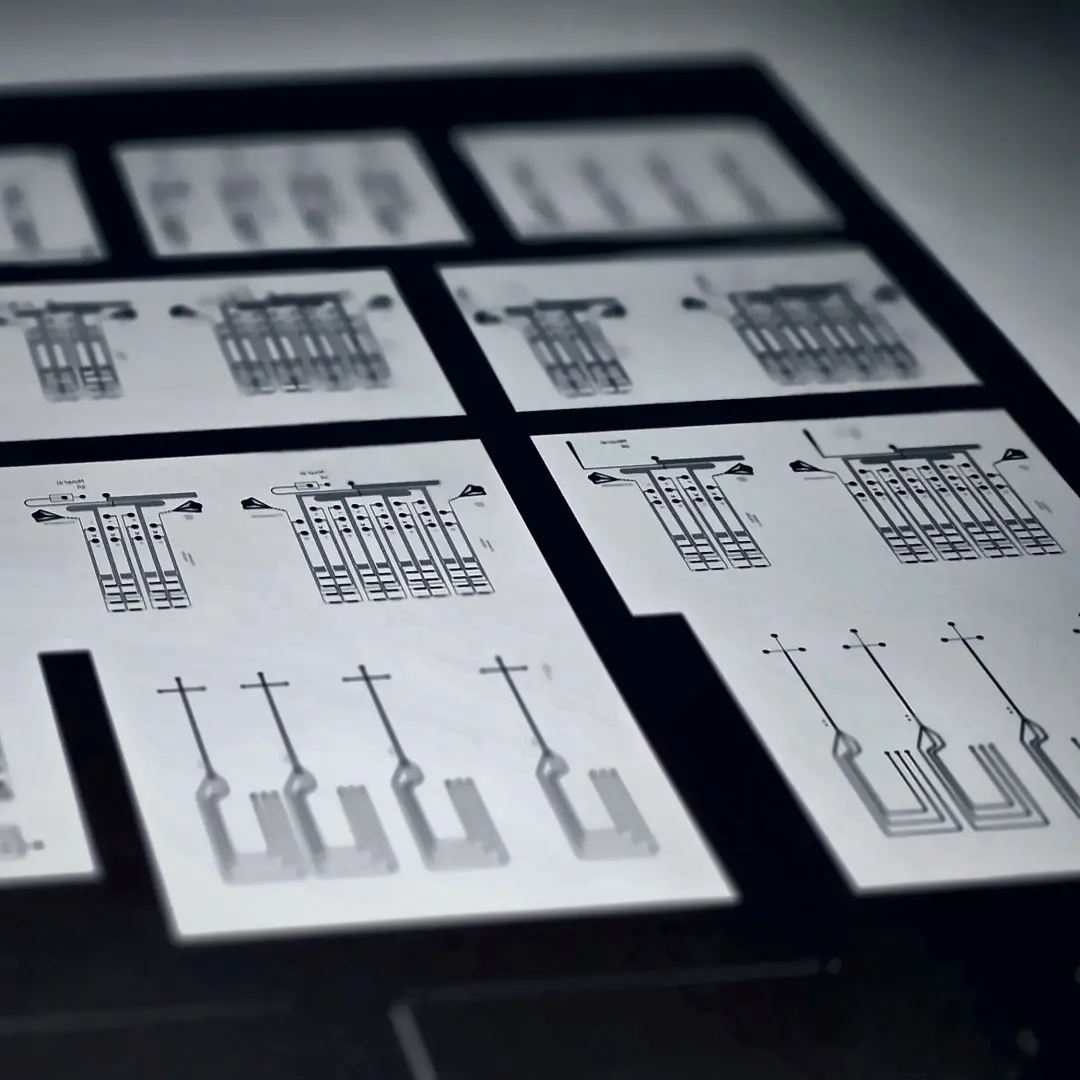
For applications where the dimensional stability of glass is not a process requirement, Selba’s film photomasks offer a compelling combination of pattern accuracy, format flexibility, and production economics that glass cannot match on cost or turnaround. Produced at up to 50,800 dpi, film photomasks deliver sharp edge definition and consistent feature geometry across a broad range of applications — from PCB conductor patterns and microfluidic channel artwork to encoder graduations and custom optical apertures. Turnaround is fast: orders cleared through Selba’s pre-production file review are shipped within 24 hours of confirmation, allowing artwork revisions to be validated and iterated within a single working day — a critical advantage at the prototyping and development stage where frequent design changes and tight schedules make glass mask lead times impractical. Film substrates are supplied in a wide range of formats, cut to the customer’s required dimensions or produced in specific aspect ratios to match the exposure tool working area, offering format flexibility that rigid glass substrates cannot provide. For customers managing development budgets across multi-stage programmes, film photomasks allow prototyping and early validation to be conducted at a fraction of glass mask cost — preserving budget for the production stage where glass is required. As with all Selba orders, submitted artwork is reviewed by the R&D team before production begins, ensuring that resolution limits and process constraints are resolved before the first film is run.
Motion Feedback
Product Description
Selba’s film photomask service covers applications across printed circuit board manufacturing, photochemical machining, encoder disc production, and industrial patterning processes where film’s handling flexibility and format adaptability are process advantages.
- PCB & Electronic Fabrication
- Photochemical Machining
- Microfluidics & Biomedical Devices
- R&D, Prototyping & Academic Research
PRODUCT SPECIFICATIONS
Technical Details
High-Resolution Laser Photoplotting on Film Substrates.
Film photomasks are produced using Selba’s laser photoplotting capability, operating at up to 50,800 dpi, ensuring sharp edge definition and consistent pattern accuracy across the full film area. This resolution level supports fine-feature geometries suited to PCB conductor patterns, etching artwork, and custom graduation patterns, with positional accuracy maintained across the full working format.
Film substrates offer practical advantages over glass in applications where cutting to a specific format, rolling, or handling flexibility is operationally relevant. They are particularly well suited to photochemical machining workflows, where the mask must conform to non-planar or large-format workpieces, and to prototyping environments where rapid design iteration takes priority. Standard input formats including Gerber and DXF are accepted directly, and orders that clear the pre-production file review are shipped within 24 hours of confirmation — one of the shortest lead times available in precision photomask supply.
Up to 50’800 dpi
24-hour turnaround
Gerber & DXF formats
Flexible format sizing
High optical density emulsion
Single-day iteration cycle
PRODUCT SPECIFICATIONS
Custom Services
Fast Turnaround Without Compromising Process Integrity.
Every film photomask order begins with a structured review of the submitted artwork by Selba’s R&D experts. Feature geometries, line widths, and critical dimensions are assessed against the intended photolithographic process before production is initiated — ensuring that resolution limits, emulsion characteristics, and format constraints are accounted for before the first film is run. This upstream review is a standard part of the Selba service and is what underpins the reliability of the 24-hour shipment commitment for cleared orders.
For customers at the prototyping stage, the combination of fast turnaround and direct engineering access allows rapid design iteration — artwork can be revised, reviewed, and reproduced in a single working day. For small series and volume programmes, consistent process parameters and inspection protocols across batches ensure that film masks produced in successive runs perform identically within the customer’s exposure process. Selba supports customers from initial artwork preparation through substrate selection, format specification, and process integration, providing a technically grounded supply relationship rather than a transactional one.
CUSTOM & MASS PRODUCTION
Industrial Applications
Technical Details
Industrial Applications
Custom Services
The choice between film and glass photomasks is fundamentally a question of matching the mask specification to the precision, durability, and economic requirements of the application — and understanding where the performance trade-offs between the two become relevant. On cost, film photomasks are substantially less expensive than glass equivalents, making them the practical choice for prototyping, R&D, and any application where frequent design iteration or large-format artwork makes the recurring cost of glass masks prohibitive. On turnaround, film’s advantage is equally clear: Selba ships film photomasks within 24 hours of artwork approval, while glass photomask production involves additional process steps — substrate preparation, chromium deposition, and post-patterning inspection — that extend lead times accordingly. On precision, glass holds the decisive advantage: the dimensional stability of glass substrates under thermal and humidity variation preserves pattern placement accuracy and graduation pitch in ways that polyester film cannot match, making glass the required choice wherever overlay accuracy, feature placement repeatability, or long-term pattern stability are process requirements. On durability, chromium-on-glass photomasks withstand repeated exposure cycles, chemical handling, and mechanical contact without pattern degradation, while film emulsions are more susceptible to surface damage, scratching, and dimensional drift over time — limiting film to applications where the mask is used for a defined number of exposures rather than as a long-term production tool. In practice, the two formats are complementary rather than competitive: film photomasks serve the prototyping, development, and validation phases of a programme, where speed and cost take priority, while glass photomasks serve the production phase, where precision, repeatability, and durability are non-negotiable. Selba produces both, allowing customers to transition seamlessly between the two as their programme matures — with the same R&D-led file review and engineering support applied at every stage.