Film Photomasks and the Economics of Iteration
The choice between a film photomask and a glass one is usually framed as a question of resolution. More often it is a question of how many times you expect to be wrong before you are right.
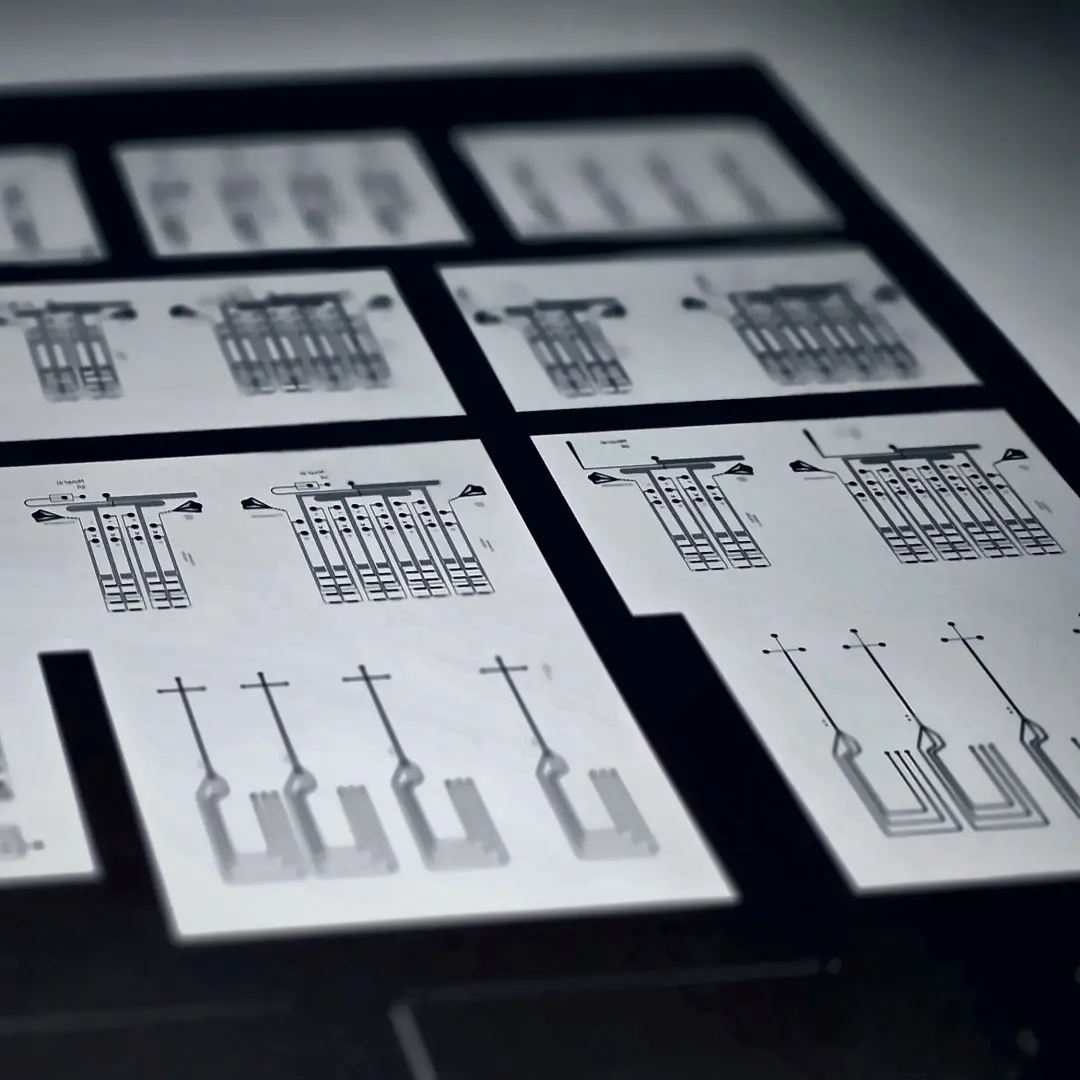
A Selba nanofluidic film photomask. © Selba
The real cost is iteration
Research rarely arrives at the correct geometry on the first attempt, and the cost that decides a prototyping budget is not the price of one mask but the price of waiting for each successive one.
Consider how early-stage work actually proceeds. A microfluidic chip is laid out, fabricated and tested; the fluid behaves in a way the model did not predict; the channels are redrawn and the cycle begins again. A test structure in a nanotechnology programme is patterned, measured, and revised once the first results come back. Each turn of that loop needs a mask, and each mask that takes a week to arrive turns a fortnight of experiments into a month of waiting. Multiply that across five or six iterations and the schedule, not the science, becomes the constraint.
Cheap, fast, and good enough
Film earns its place in exactly this phase. It is markedly cheaper than glass, its resolution — the minimum feature of a Selba film photomask is 7 µm for a line, 12 µm for a circle — is sufficient for a wide range of microfluidic channels and prototype features, and it can be produced quickly. For a laboratory or a young company still searching for the right design, that combination changes what is affordable. You can test a variant you are unsure about, because being wrong no longer costs a week and a meaningful fraction of the budget.
The waiting is the variable worth attacking, and it is the one Selba addresses directly. A film photomask turned around in 24 hours is short enough to change how a research group plans its week. A design settled on Monday can be in use on Tuesday; the revision that Tuesday’s results suggest can be ordered the same evening and tested on Thursday. Iteration stops being a sequence of pauses, each one long enough to break concentration, and starts to resemble a continuous process. That is closer to how good experimental work wants to proceed, where one result feeds the next while the question is still fresh.
For an academic group the calculus is sharper still. Grant timelines are fixed, students graduate, and a process that stalls for a fortnight waiting on glass can cost a term. A supply of inexpensive masks delivered overnight lets the experimental schedule follow the questions rather than the procurement queue, which is the difference between a project that iterates ten times in a year and one that manages four. The science a group can do is bounded, in practice, by how fast it can try things.
Where film stops
None of this is an argument against glass. For a mature design heading into production, for the finest feature sizes, and for runs that demand the flatness and durability only a rigid substrate provides, glass remains the right answer. The point is narrower and more practical: prototyping and production have different economics and treating them as the same is how research budgets get spent on durability the work does not yet need. A design that will be revised six times gains nothing from being committed to glass on its first version.
It helps to be honest about where film stops. The very smallest features, the sub-micron geometries of advanced lithography, belong to glass or to direct-write methods, and film is not pretending to compete there. What it covers is the broad middle ground where most prototyping lives: channel widths, electrode patterns, alignment marks and test structures measured in microns rather than fractions of one. For most early-stage devices that range is exactly the range that matters, and paying for finer resolution would only buy a precision the design cannot yet use.
Masks you don’t keep
There is something almost liberating in a mask you do not have to keep. The film versions that carry a project through its uncertain middle are not heirlooms; they are scaffolding, used while the design is found and discarded once it is. A fast, inexpensive supply of them lets a team treat fabrication as part of thinking rather than a separate, slower stage that thinking must wait for. The quickest route to a finished design often runs through a stack of film masks no one remembers a year later.
The fields where this matters most are the ones moving quickly and working small. Microfluidics, with its lab-on-chip devices and ever-changing channel geometries, lives on iteration. Nanotechnology research, qualifying new structures and processes, lives on it too. In both, the bottleneck is rarely the idea; it is the time between having an idea and being able to test it. Shorten that gap and the work accelerates on its own. A 24-hour mask is a small lever on a large problem, which is precisely why it is worth having.
Discuss your project with Selba
Every encoder disc, scale and photomask is made entirely to your specification. Tell us your requirement and our engineers will assess feasibility, tolerances and lead time.
Request a quote