
Fine Glass Machining
Product in details
Precision Glass Processing
Glass is among the most demanding materials to machine with precision — brittle by nature, sensitive to thermal shock, and prone to sub-surface crack propagation from even minor mechanical overload. Achieving tight dimensional tolerances on glass, particularly on thin substrates where fracture risk is highest, requires controlled process parameters and a deep understanding of how the material responds at each stage of the machining sequence. At Selba, this understanding has been translated into a proprietary glass machining capability built around equipment designed and built entirely in-house — configured specifically for the substrate materials, thickness ranges, and dimensional tolerances that precision optical component manufacturing demands.
The integration of glass machining and photolithographic patterning within a single facility is what makes Selba’s capability particularly distinctive.
Every machined component undergoes dimensional inspection before release, covering external geometry, edge condition, and — where applicable — registration between machined features and the optical pattern they reference.
- Optics & Photonics
- Precision Instrumentation & Metrology
- Medical Devices & Imaging Systems
- Watchmaking & High-End Micro-Mechanics
PRODUCT SPECIFICATIONS
Technical Details
Complex Profiles. Tight Geometric Indexing. Substrates to 0.1 mm.
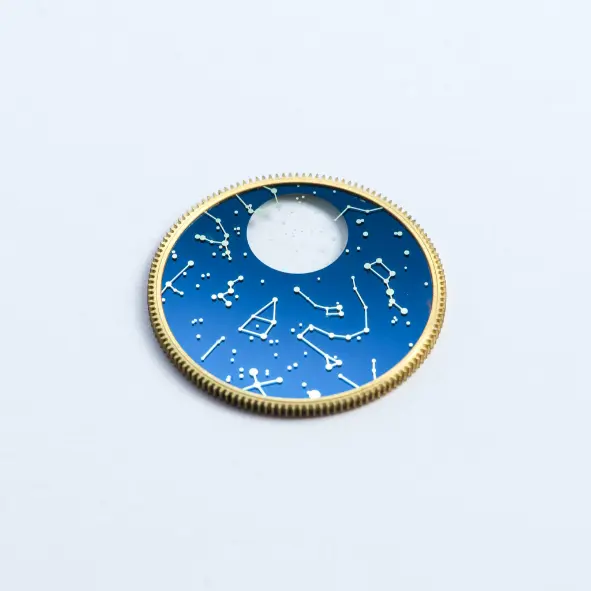
Selba’s glass machining operations cover cutting, edge profiling, drilling, and chamfering across a range of substrate materials including sodalime glass, quartz, and thin specialty substrates. The department’s machinery — designed in-house — is configured to maintain precise geometric indexing between the machined external shape and the photolithographic pattern the substrate carries, ensuring that the positional relationship between the optical pattern and the mechanical form of the finished component is held to the tolerances required by the assembly it will enter.
Drilling operations are supported on substrates as thin as 0.1 mm, with surface finish quality maintained throughout. Chamfered edge profiles are available for large-format substrates — including encoder discs up to 200 mm and beyond — where edge geometry is used to redistribute mechanical stress and improve structural rigidity without adding substrate mass. Custom tooling parameters are developed in-house for non-standard geometries, allowing Selba to address machining requirements that fall outside the capability envelope of standard glass processing suppliers.