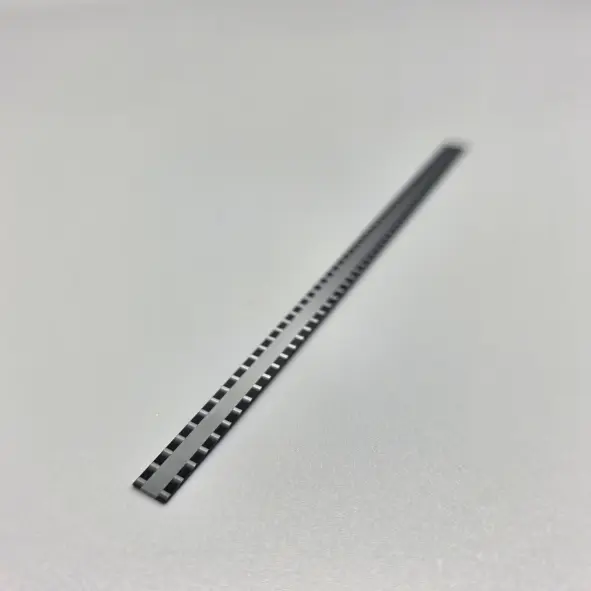
Optical Linear Scales

Selba’s optical linear scales provide direct, high-accuracy position feedback for precision motion systems, ensuring repeatable linear measurement across industrial, scientific, and high-tech applications.

Product in details

Optical Linear Scales Manufacturing

Optical linear scales are the foundational measurement components in any system where linear position must be determined directly, accurately, and repeatably — from CNC machining centres and semiconductor lithography stages to coordinate measuring machines and photonic test equipment. At Selba, every scale is produced entirely to customer specification, with graduation pitch, substrate material, scale length, and coating defined in collaboration with the customer’s engineering team and validated through a structured pre-production file review before production begins. Graduation patterns are produced at up to 50,800 dpi, delivering fine-pitch incremental and absolute graduation lines with consistent width, sharp edge definition, and micron-level pitch accuracy along the full scale length. Substrate selection — sodalime glass for standard industrial applications, quartz for thermally demanding environments, and aluminium or aluminium-coated film where weight or reflectivity requirements apply — preserves pitch accuracy and signal stability across operating conditions. Standard and antireflective chromium coatings are matched to the optical contrast and signal-to-noise requirements of the customer’s readhead configuration. Long-term reliability is ensured through wear-resistant chromium coatings, controlled edge profiles, and the integration of patterning and machining within a single facility — eliminating tolerance stack-up between graduation pattern and mechanical mounting datum, and maintaining full production traceability across the lifetime of the system the scale serves.

Motion Feedback

Product Description

Committed to continuous innovation, Selba is actively developing encoder discs and scales on aluminium substrates, qualifying sheets as thin as 0.2 mm for applications requiring low weight and mechanical rigidity. Aluminium-coated film variants are also under development for customers requiring high reflectivity combined with cost-competitive production — broadening Selba’s substrate portfolio in response to evolving requirements across motion control and precision measurement markets.

  • Industrial Automation & Robotics
  • CNC Machining Centres
  • Semiconductor & Nanofabrication
  • Medical & Scientific Equipment
Selba's Optical Linear Scale

PRODUCT SPECIFICATIONS

Technical Details

Every Dimension. Every Specification. No Standard Catalogue.

Selba designs and manufactures incremental and absolute encoder discs and linear scales entirely to customer specification — there are no standard products. Graduation patterns, track layouts, index marks, and aperture geometry are defined in close collaboration with the customer’s engineering team to match the exact resolution, signal format, and mechanical interface of the target encoder system.
Encoder discs are available on glass, film, and aluminium substrates across a continuous diameter range from 20 mm to 200 mm, with discs up to 290 mm available upon special request. Glass substrates are specified for applications demanding high dimensional stability and thermal resistance. Film substrates offer a cost-effective alternative for less demanding environments, while aluminium — available in sheets as thin as 0.2 mm — addresses applications where low weight and compact assembly integration are priorities. Aluminium-coated film variants are also available for applications requiring high reflectivity combined with cost-competitive production.
Linear scales are produced on glass and film with pitch accuracy and edge definition governed by Selba’s high-resolution laser photoplotting process, operating at up to 50,800 dpi. Pattern fidelity across the full graduation length is verified as part of the standard inspection protocol.

High-resolution laser photoplotting

Up to 50,800 dpi

Ultra-low thermal expansion

≈0.55 ppm/°C (quartz)

Industrial-grade stability

≈9 ppm/°C (sodalime)

Ultra-thin substrate capability

Down to 0.1 mm (glass)

Lightweight integration options

CDown to 0.2 mm (aluminium)

Controlled graduation precision

Micron-level pitch accuracy

PRODUCT SPECIFICATIONS

Custom Services

From File Review to Finished Component.

Selba’s encoder disc and linear scale service covers the full production workflow, beginning upstream of manufacturing. Every order — whether a single prototype or a production batch — starts with a structured file review carried out by Selba’s R&D experts. Submitted artwork is assessed against the intended substrate, photolithographic process, and mechanical constraints before production is initiated, ensuring that design intent is preserved through to the finished component.
For prototyping and first-article validation, Selba’s integrated photolithography and glass machining capabilities operate within a single facility, allowing rapid turnaround without subcontractor dependencies. As programmes mature into small series or mass production, the same process parameters, substrate materials, and inspection protocols are maintained across batches, providing the repeatability that encoder system integrators require for consistent downstream performance. Full traceability is maintained throughout the production chain, and engineering support remains available at every stage for customers refining track geometry, exploring alternative substrate materials, or scaling production volumes.

Pre-Production File Review
Rapid Prototyping & First Article
Scalable & Repeatable Production

CUSTOM & MASS PRODUCTION

Industrial Applications

Technical Details

Selba produces optical linear scales on sodalime glass (≈9 ppm/°C), quartz (≈0.55 ppm/°C), film, and aluminium substrates — selected to match the dimensional stability, thermal, and optical requirements of the application. Quartz, approximately fifteen times more thermally stable than sodalime, is specified wherever thermal pitch drift along the scale length would introduce systematic positioning error. Graduation patterns are produced in standard or antireflective chromium, the latter suppressing back-reflection in close-working-distance and high-resolution readhead configurations. Scale lengths, widths, and thicknesses are defined entirely to customer specification — glass substrates are processable down to 0.1 mm, aluminium down to 0.2 mm — with no standard catalogue formats. Precision is controlled at three levels: micron-level graduation pitch accuracy and line placement via laser photoplotting at up to 50,800 dpi; external geometry and end profiles machined with custom in-house tooling; and graduation-to-mounting-datum registration controlled end-to-end within a single facility, eliminating inter-supplier tolerance stack-up. Coating uniformity, edge sharpness, freedom from defects, and substrate flatness are verified by optical inspection before every scale is released.

Industrial Applications
Selba’s optical linear scales serve as the primary linear position reference across a broad range of precision engineering disciplines. In industrial automation and robotics, they provide the direct axis feedback that governs positioning repeatability, gantry coordination, and linear stage control in assembly, handling, and dispensing systems — eliminating the drive train compliance and backlash errors that indirect rotary encoder measurement cannot correct. In CNC machining centres, linear scales mounted directly on machine axes close the position loop at the point of cutting, compensating for ballscrew wear, thermal expansion, and structural compliance to deliver the dimensional accuracy and surface finish repeatability that production quality requires. Aerospace applications specify quartz substrate scales for their exceptional thermal stability across the extreme temperature ranges encountered in airborne and space environments, supporting flight control actuation feedback, antenna positioning, and precision deployment mechanism sensing where long-term reliability without maintenance access is a fundamental requirement. Medical device platforms — including surgical robotic systems, radiotherapy equipment, CT scanners, and motorised diagnostic instruments — depend on linear scale feedback for the sub-millimetre positional accuracy and batch-to-batch component consistency required by regulated manufacturing environments, supported by Selba’s full production traceability and the quality management framework progressing toward ISO 9001 certification by Q1 2027. In nanoprinting and nanofabrication equipment, where stage positioning is measured in nanometres and feature placement accuracy is the defining performance metric of the system, graduation pitch error in the linear scale sets an irreducible floor on achievable patterning precision — making scale quality inseparable from equipment capability.
Custom Services
Selba’s linear scale offering is built entirely around custom design and engineering collaboration — every scale produced is unique to the application it serves, with no standard catalogue formats constraining the customer’s design freedom. Graduation patterns, pitch, track layout, reference mark positioning, and absolute coding configurations are developed from the ground up to match the resolution, accuracy, and signal format requirements of the target encoder system, with Selba’s R&D team reviewing every submitted artwork file before production begins — verifying pitch specification, assessing process compatibility, and identifying any geometry that would compromise pattern fidelity or signal quality in the finished scale. For customers at the prototyping stage, Selba’s integrated photolithography and substrate machining capability enables fast first-article turnaround without subcontractor dependencies, allowing graduation geometry, substrate material, and coating specification to be validated quickly and iterated efficiently before design freeze. As programmes transition from prototype validation into small series qualification or volume production, the same process parameters, substrate specifications, and inspection protocols established during development are maintained without variation, ensuring that every scale in a production batch performs identically to the first article the customer approved. Throughout the programme lifecycle, Selba’s engineering team remains directly engaged — supporting customers with substrate selection, coating specification, graduation design optimisation, inter-track registration for absolute scales, and artwork revision management — providing the technically grounded partnership that precision encoder development demands at every stage from concept to series supply.

Use Case

A compact reflective scale to sit at the heart of a new readhead design.

“a 20 µm pitch read in reflection, requiring sharp, evenly placed lines and high optical contrast between the reflective and non-reflective zones for the readhead to resolve position cleanly.”

FAQ

Frequently asked questions

What is an optical linear encoder?
An optical linear encoder is a measurement system that determines linear position or displacement by reading a precision graduation pattern on an optical scale. It consists of two principal components: the linear scale — a substrate carrying a photolithographically produced graduation pattern — and the readhead, which houses the light source, optics, and photodetector assembly that reads the scale. Together, they form a closed-loop feedback element that converts physical linear displacement into a high-resolution electrical signal used by motion controllers, measurement systems, or data acquisition equipment. Unlike rotary encoders, which measure angular position on a rotating shaft, linear encoders measure displacement along a straight axis — making them the feedback element of choice wherever direct linear position measurement is required, free from the backlash, leadscrew error, and drive train compliance that affect indirect measurement through rotary encoders on ballscrews or rack-and-pinion drives.
How does an optical linear encoder work?
An optical linear encoder works by detecting the relative movement between a graduation scale and a readhead as one travels along the other. The readhead projects light onto or through the graduation pattern on the scale — a precisely defined sequence of opaque and transparent lines produced photolithographically at a controlled pitch. As the readhead moves, the alternating segments modulate the transmitted or reflected light reaching the photodetector, generating a sinusoidal or square-wave electrical signal with a period corresponding to the graduation pitch. This signal is processed by the encoder electronics to determine displacement, direction of travel, and velocity. In incremental systems, displacement is counted from a known reference position; in absolute systems, a unique pattern of tracks encodes position unambiguously along the full travel range, eliminating the need for a reference return at power-up. The resolution of the system — the smallest detectable displacement — is determined by the graduation pitch of the scale and the interpolation factor applied by the readhead electronics, with finer pitch and higher interpolation yielding finer resolution.
What industries use optical linear encoder scales?
Optical linear encoder scales are used across any industry where direct, high-accuracy linear position measurement is required. CNC machining centres mount linear scales directly on machine axes to provide closed-loop feedback that eliminates the positioning error introduced by drive train compliance, ballscrew wear, and thermal expansion — directly governing cutting accuracy, surface finish, and part dimensional repeatability. Semiconductor lithography and nanofabrication equipment relies on linear encoder feedback for the nanometre-level stage positioning that determines feature placement accuracy in wafer exposure and direct-write processes. Precision metrology instruments — including coordinate measuring machines, surface profilers, and optical comparators — use linear scales as their primary length reference, where scale accuracy is inseparable from instrument measurement uncertainty. Industrial automation, robotics, and gantry systems use linear encoders for precise axis feedback in pick-and-place, assembly, dispensing, and handling equipment. Medical imaging and radiotherapy platforms depend on linear scale feedback for table positioning and detector travel, while photonic and optical test equipment uses it for the fine axis control required in fibre alignment, interferometry, and optical component characterisation.
What materials are used for optical linear encoder scales?

The substrate material of a linear encoder scale is one of the most consequential design decisions in the encoder system, as it determines how the scale’s graduation pitch — and therefore the encoder’s positional accuracy — behaves under thermal, mechanical, and environmental operating conditions. Selba produces linear scales on four substrate families. Sodalime glass is the standard choice for the majority of industrial and instrumentation applications, offering good dimensional stability, consistent surface flatness, and full compatibility with chromium photolithographic patterning across standard temperature ranges. Quartz (fused silica), with a thermal expansion coefficient approximately fifteen times lower than sodalime, is specified for high-accuracy metrology, semiconductor lithography, and precision scientific instrumentation where thermal pitch drift along the scale length would otherwise limit system accuracy. Film substrates offer a cost-effective and handling-flexible alternative for applications where glass-grade dimensional stability is not required, and are particularly suited to large-format scales or prototyping programmes where rapid turnaround takes priority. Aluminium substrates — available in sheets as thin as 0.2 mm — address weight-constrained and compact integration applications, while aluminium-coated film variants serve systems combining a high-reflectivity graduation surface with cost-competitive production volumes.

What level of precision can be achieved with optical linear encoder scales?
The precision achievable with an optical linear encoder scale is determined by three interacting factors: the graduation pitch accuracy of the scale itself, the interpolation capability of the readhead electronics, and the thermal stability of the substrate under operating conditions. Selba’s linear scales are produced using high-resolution laser photoplotting at up to 50,800 dpi, enabling fine-pitch graduation lines with consistent width, sharp edge definition, and tight pitch accuracy along the full scale length — the parameters that set the fundamental accuracy floor of the encoder system. At the graduation level, Selba controls line placement accuracy and pitch uniformity to micron-level tolerances, verified by optical inspection before every scale is released. Substrate selection extends this precision into the thermal domain: sodalime glass substrates suit applications tolerating thermal pitch variation within standard industrial temperature ranges, while quartz substrates preserve graduation pitch accuracy across wide temperature excursions, preventing the systematic positioning error that thermal expansion would otherwise introduce. For the most demanding applications — including coordinate metrology, semiconductor stage feedback, and high-resolution scientific instrumentation — the combination of quartz substrates, antireflective chromium coatings, and Selba’s micron-level patterning accuracy supports linear encoder systems operating at the limits of achievable measurement performance.