
Precision as a Prerequisite: Optical Components for Space
In space the errors that matter are measured in fractions of an arc-second — an angle so small it means nothing on a workbench, yet opens to roughly 175 metres on the ground at geostationary altitude.
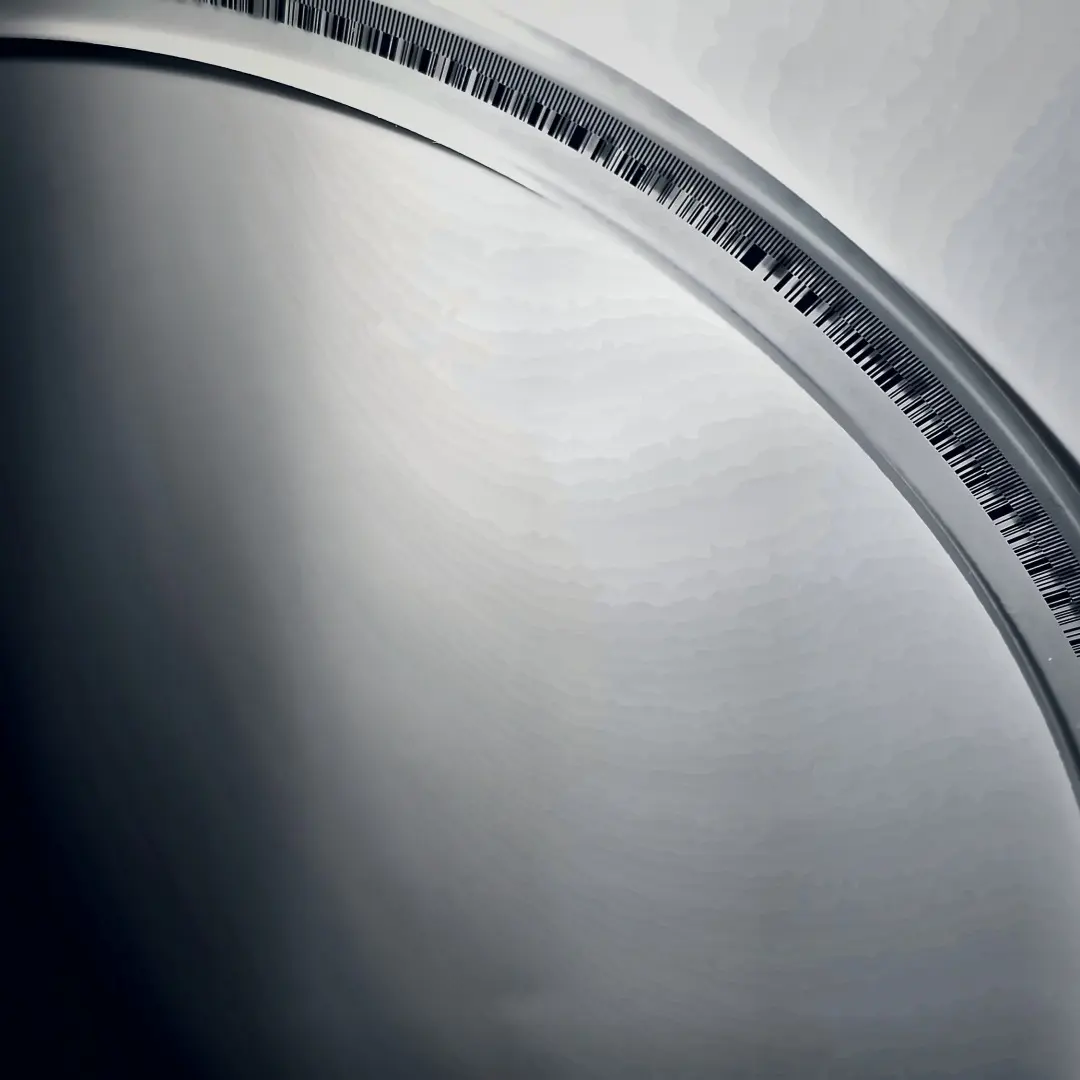
A large Selba glass encoder disc. © Selba
The cost of an arc-second
One arc-second is a 3,600th of a degree, an angle so small it means nothing on a workbench. Project it across the distance a spacecraft works over and it stops being abstract: at the altitude of a geostationary satellite, a single arc-second of pointing error opens to roughly 175 metres on the ground. An instrument that has to place its beam, its field of view or its measurement on a precise target has very little room to be wrong, and most of that allowance is spent before launch.
Much of it is spent in the encoder. The angular position of a pointing mechanism is read from a graduated disc, and that disc is the physical reference the whole control loop trusts. If the graduation is true to a fraction of an arc-second, the instrument knows where it is looking. If it drifts, every correction the spacecraft makes is built on a false reading. The precision of that one component sets a ceiling on the precision of everything downstream of it.
What cannot be fixed in orbit
The same logic runs through the other optical references a programme depends on. Reticles, precision graduations and photomasks fix the patterns that detectors are calibrated against and that optics are aligned to. None of these can be adjusted once they are in orbit. An instrument cannot be recalled, opened and re-trued by hand, so the tolerance committed to a graduation at manufacture is the tolerance the mission carries for its full 15-year life. A pattern that was very slightly off on the day it shipped will be exactly that much off a decade later, in every reading taken from it.
Consider a star tracker, the small camera that fixes a spacecraft’s orientation by recognising the pattern of stars in its field. Its accuracy is qualified on the ground against reference patterns whose geometry must be known to a far finer tolerance than the tracker itself, because a calibration reference no better than the instrument it checks tells you nothing. The reticles and graduated targets used in that qualification are doing precision’s least visible job: being more correct than the thing they certify.
And the conditions punish any weakness. A component that ships to orbit endures the vibration of launch, the vacuum and thermal cycling of space, and years of radiation, with no maintenance and no second chance. A graduation that holds at room temperature on a bench is not the same as one that holds through all of that. Qualifying a part for the environment it will live in is as much of the work as making it accurate in the first place, and it is why the margin built in at manufacture has to be generous as well as fine.
Equipment, and the habit behind it
Holding a disc or a mask to a fraction of an arc-second is partly a matter of equipment and partly a matter of habit. The equipment is laser photoplotting at high resolution. The habit is checking the work at each stage of production rather than trusting a single inspection at the end, and it is the harder of the two to acquire. It is the accumulated practice of a firm that has been drawing fine patterns since 1948, and it is the part of the craft that never appears on a datasheet. Selba’s history is mostly this: decades of narrowing the gap between what a drawing specifies and what a finished component actually holds.
Independent, and Swiss
That continuity is itself a feature for a space or defence client. An independent house does not see its know-how dispersed across a portfolio or redirected by a parent’s priorities. The people who understood a difficult job last year are the people doing it this year. For programmes that run over a decade and depend on a supplier still being there, and still being good, at the end of it, independence is closer to a guarantee than a sentiment.
There is a second point such clients raise early, and it has nothing to do with optics. It concerns where their design files are kept. A drawing for a flight instrument is sensitive, sometimes classified, intellectual property, and the question of which country’s law governs the servers that hold it is no longer a technicality. Selba keeps its data in Switzerland. For a European prime contractor weighing where to send its most confidential work, that is a line on the tender, not a footnote beneath it.
Precision, in this field, is rarely about a single heroic tolerance. It is about a chain of small certainties: a graduation that holds, a reference that does not drift, a supplier that will still be independent and discreet when the mission is halfway through its life. The components are unglamorous and the distances they answer to are not. Across them, a fraction of an arc-second is the difference between a measurement that lands and one that misses.
Discuss your project with Selba
Every encoder disc, scale and photomask is made entirely to your specification. Tell us your requirement and our engineers will assess feasibility, tolerances and lead time.
Request a quote