
Coloured Glass Filters: The Trade-Off Watchmaking is Rediscovering
A coloured watch dial is almost never made of the colour you think you see. Between prestigious sapphire, low-cost plastic, and glass — it is the last that deserves a closer look.
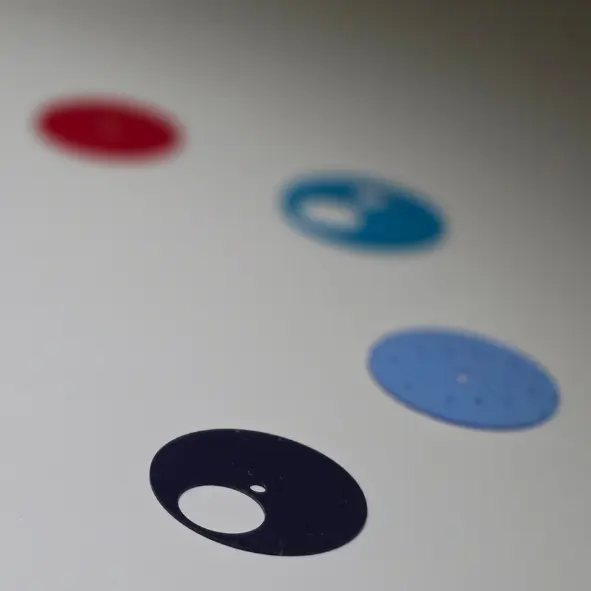
Coloured glass filter machined by Selba, Versoix. © Selba
Sapphire does not colour well — and that is not a minor detail
Sapphire glass owes its reputation to hardness. Synthetic corundum crystallised above 2,000 °C, it is second only to diamond on the Mohs scale and withstands virtually everything a wrist encounters in a day. That is why it has dominated high-end watchmaking since the 1960s — first as a protective crystal, then as a structural component in its own right.
But this quality comes with a trade-off that rarely makes it into commercial briefs: sapphire accepts colour poorly. Its highly ordered crystal structure limits the dopants that can be introduced without degrading transparency or mechanical integrity. As a result, coloured sapphires on the market tend to be pale and washed-out, with saturation levels that cannot match what a standard glass achieves. Some manufactures work around this by positioning the subtlety of the tint as an aesthetic argument. Others — wanting a deep red or a clean blue on a dial — run into a physical wall rather than a limitation of the colourist's craft.
Add to this a high production cost and a machining difficulty that follows the same logic as the material's hardness: the harder it is to scratch, the harder it is to shape. Drilling, profiling, or chamfering sapphire requires aggressive diamond tooling, reduced cutting speeds, and very low tolerance for error — a machining defect on a material as brittle in flexion as this one quickly results in a broken part at the end of the process.
Plastic: the solution chosen when there is no other choice
At the other end of the spectrum, polycarbonate or PMMA filters offer near-total freedom of colouration. The bulk can be doped with organic pigments, the tint adjusted in small increments, and production runs can be large and inexpensive. This is the solution found in entry-level watches and in certain fashion pieces where the product lifecycle does not justify a higher material investment.
The downside is familiar to anyone who has worn an inexpensive watch for more than two years: plastic scratches easily, yellows under UV, deforms slightly with heat, and loses dimensional stability over time. For an optical filter, this drift is not merely aesthetic. A slight surface deformation changes the angle at which light is transmitted; progressive yellowing shifts the perceived colour over the years — a problem for anything claiming to hold a reference colour over time.
There is also a tooling cost that is often overlooked. A plastic disc is produced by injection moulding or die-cutting, both of which require dedicated tooling that can quickly run into tens of thousands of Swiss francs depending on geometry. This investment only amortises over large volumes. Glass, machined piece by piece or in small batches on diamond cutting machines, has no such entry threshold: it often becomes the more economically relevant choice as soon as production leaves very high volumes — which is precisely the production profile of most watch manufactures.
Glass: between the two, with its own demands
Coloured glass occupies the space left vacant between these two extremes. Unlike sapphire, its amorphous structure accepts a much broader palette of dopants and metallic oxides — cobalt, copper, selenium, cadmium depending on the tint sought — with melting recipes that sometimes go back a century of optical glassmaking (Schott and its coloured glass series are the best-documented example). The result is saturated, lot-to-lot reproducible colours, and transmission curves that can be calculated and verified by spectrophotometer rather than assessed by eye.
On durability, glass compares favourably with plastic: it does not yellow under UV, it is chemically stable, and its hardness protects it adequately from daily micro-scratching for a component not directly exposed to impact. On cost, it remains considerably more affordable than sapphire, which explains why it appears on calibration filters, mid- and high-range collection dials, and precision instrument components.
The real trade-off is machining. Glass is inherently brittle, sensitive to thermal shock, and prone to microcrack propagation as soon as a mechanical stress exceeds a relatively low threshold. Every process parameter — tool rotation speed, clamping pressure, coolant flow rate, diamond grain geometry — must be adjusted to the type of glass and its thickness, or the result will be chipped edges, subsurface cracks invisible to the naked eye, or outright breakage at the end of the part.
Where diamond machining makes the difference
This is precisely the terrain we work at Selba in Versoix (GE). We machine filters in borosilicate (and its sodalime variants) and quartz — harder and more brittle, reserved for applications requiring extreme thermal stability. On both families, Selba works down to 0.1 mm in thickness for moon phase discs. Colour filters commonly used in watchmaking typically sit between 0.5 and 0.6 mm — their thinness allows integration into the case design while still leaving room for a protective sapphire crystal.
We work on diamond cutting machines designed and built in-house, configured specifically for these thickness ranges and tolerances. The tolerances achieved are measured in microns on external profiles, edge geometries, and drillings, with 100% systematic dimensional inspection before dispatch: geometry, edge condition, and registration between the machined form and the optical pattern when the component carries one.
Diamond, laser, water jet: three different logics
Laser cutting excels at fine thicknesses and high throughputs. On glass, however, the localised heat input remains the weak point: even with ultrashort-pulse lasers, the risk of subsurface microcracking or residual stress remains higher than with a purely mechanical process — particularly on thin substrates where even minor internal tension is enough to break the part on cooling or later in service.
Water jet cuts cold, without a heat-affected zone, and handles thicknesses well beyond what laser can address. This is a genuine advantage on thick parts or composite materials. But its precision is inherently lower than guided diamond tooling, with slow cutting speeds and an edge condition that often requires a secondary operation to reach the surface quality demanded by precision optics.
Diamond machining, as practised by Selba, follows a different logic: progressive, controlled material removal, without significant heat input, with fine control over tool geometry and cutting kinematics at each stage. It is the only approach that combines micrometre-level tolerances with edge integrity on a material as unforgiving as optical glass.
A material that rewards patience
Coloured glass is not a default compromise. It offers genuine chromatic freedom, a long-term stability that plastic lacks, an accessible entry cost suited to small and medium runs, and a price that remains reasonable against sapphire. Its only requirement is that it must be worked with the right tools and a great deal of patience. It is a material that punishes approximation and rewards expertise — which is why watch manufactures seeking a clean, lasting colour tend, sooner or later, to come back to it.
Discuss your project with Selba
Every filter, dial, or coloured glass component is made entirely to your specification. Tell us your requirement and our engineers will assess feasibility, tolerances and lead time.
Request a quote